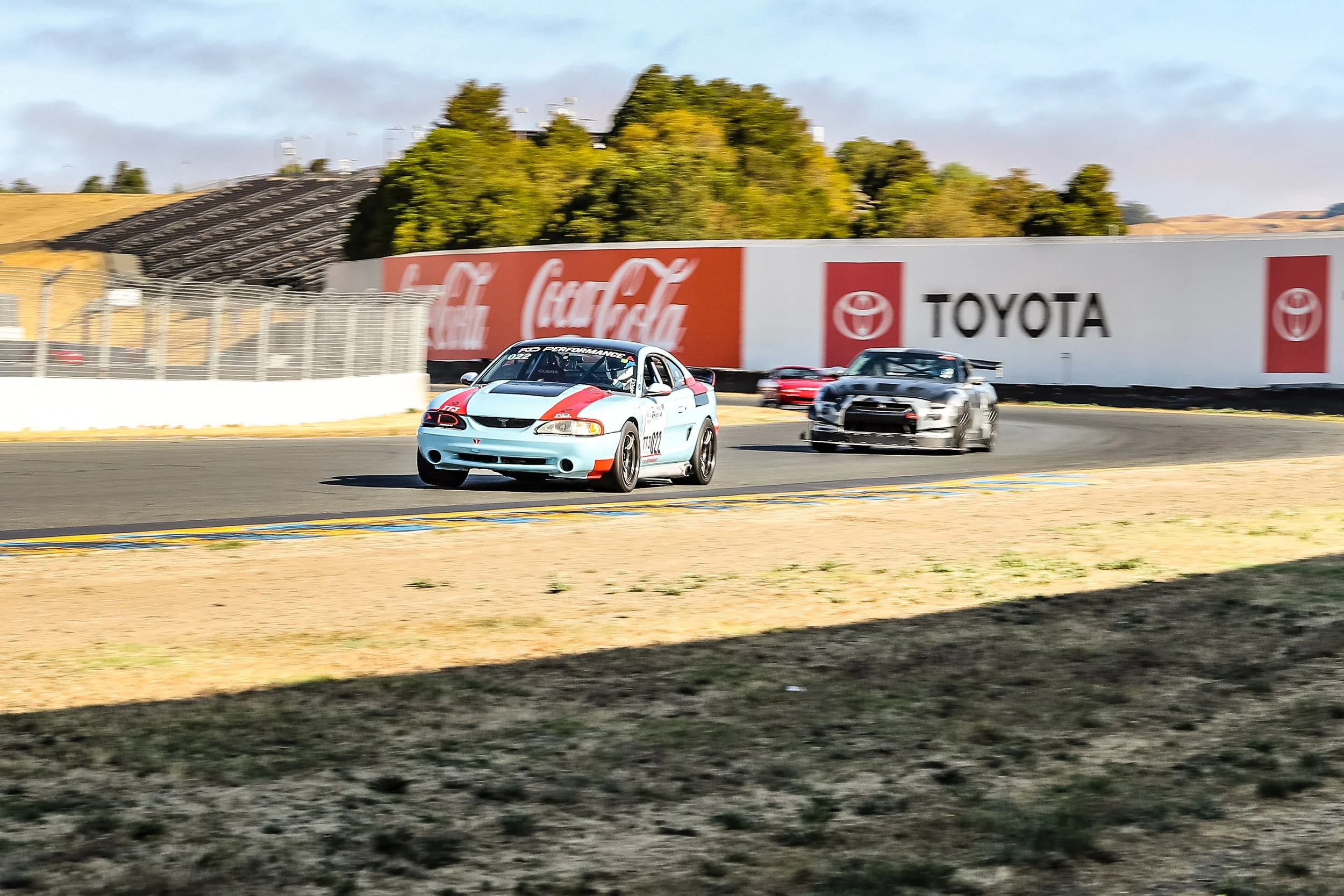
Frank’s Mustang: Fourteen-Year Honeymoon
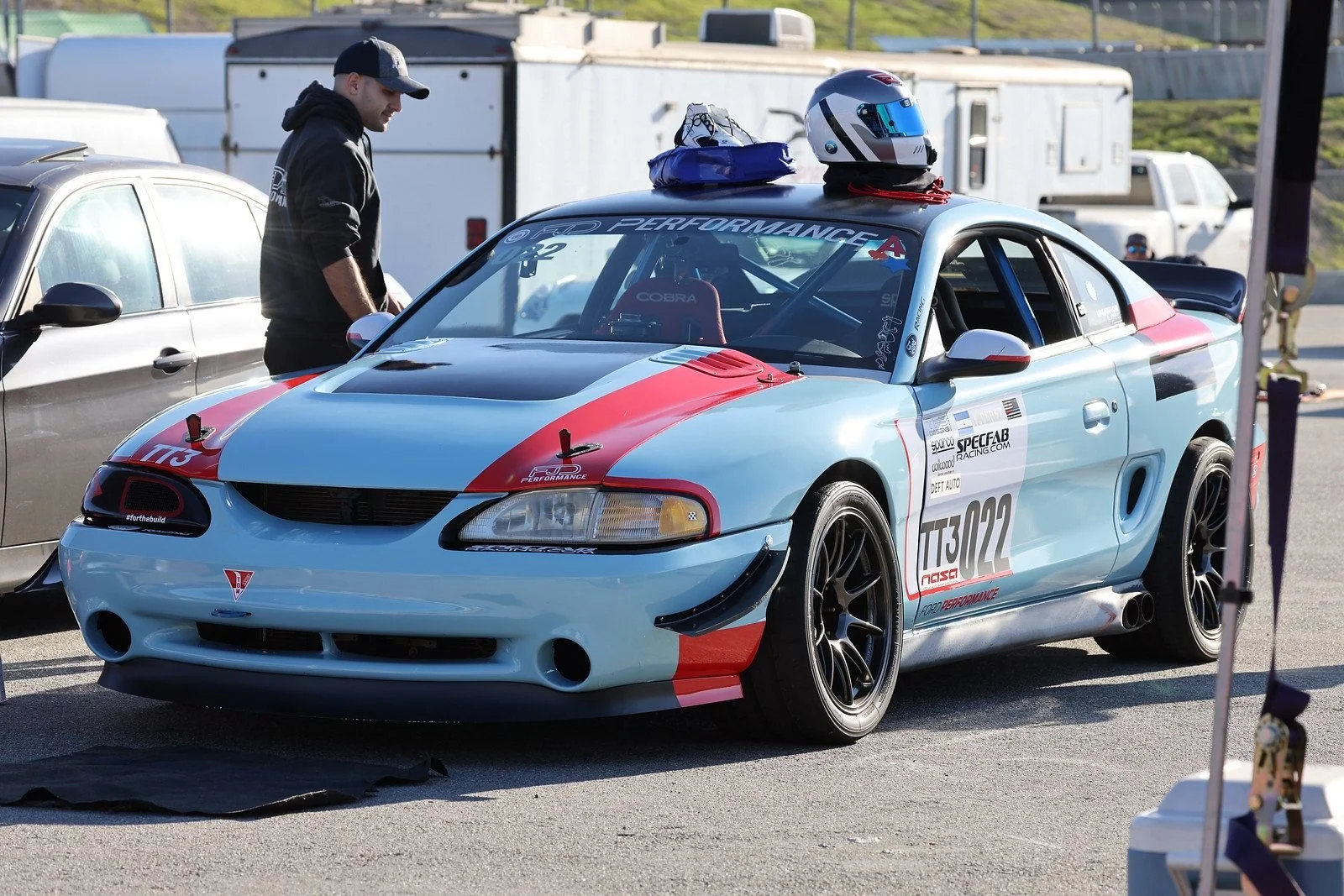
With a teenage vision of his dream SN95, Frank Perez picked up an immaculately maintained 1997 Mustang GT and embarked on a fourteen-year build that would carry him through several types of motorsport.
Its five-speed and two-valve V8 were enough to keep him entertained through their first years together, but when he was able to scrape enough together to make a stab at trackdays, he had to see how the car handled a full-sized circuit.
Running the Mustang on track highlighted its worst shortcomings. Namely, the four-link rear leaves a lot to be desired. “I started by adding Maximum Motorsport’s panhard bar and Grigg’s torque arm. The panhard locates the chassis laterally and minimizes deflection in the suspension, and the panhard bar controls the axle from rotating fore and aft, respectively. Without them, the chassis can move laterally, relative to the axle, by as much as two inches. “Those two were game-changers in terms of consistency,” he said.
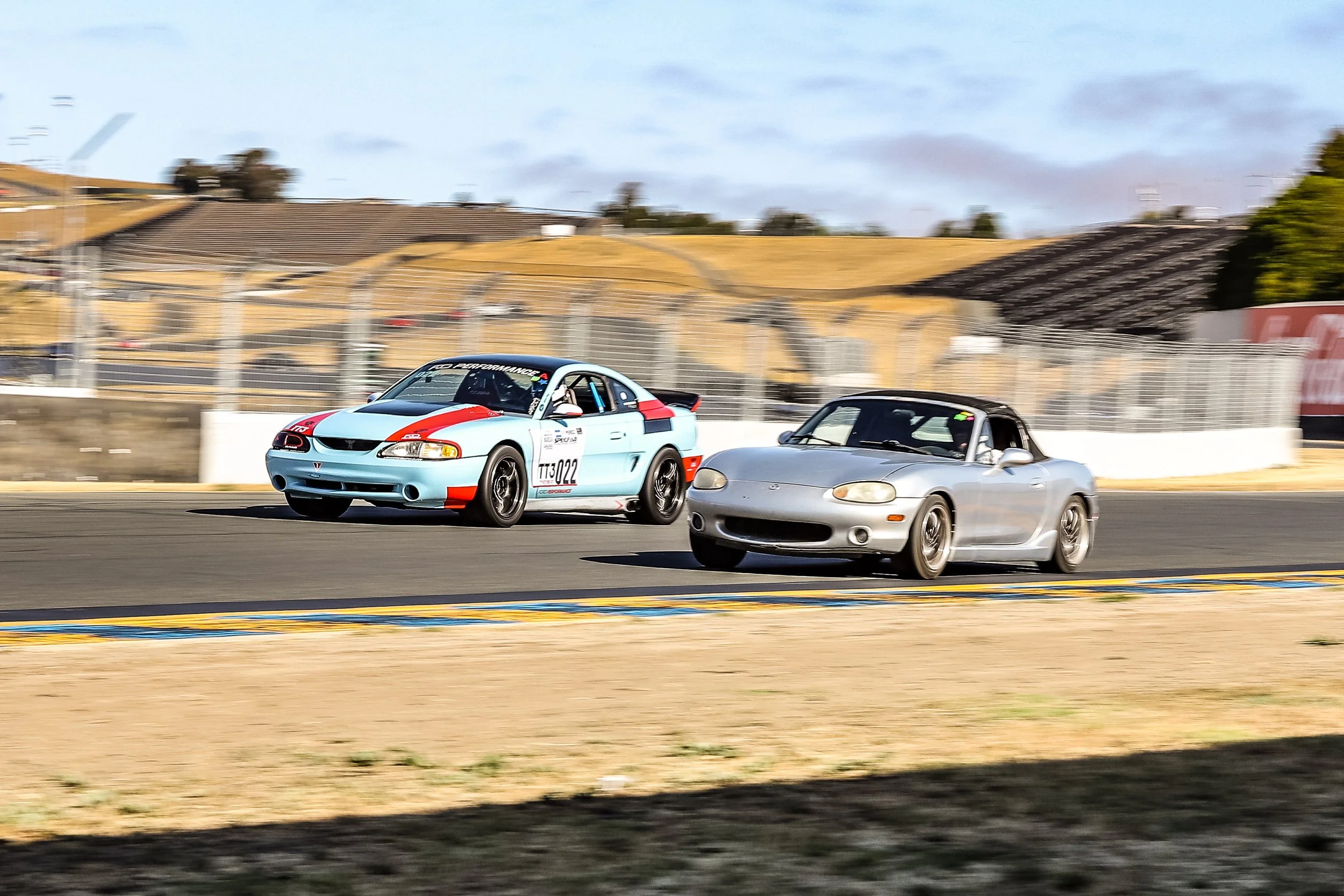
“I wanted to prioritize cornering over straight line performance, especially after getting passed in a straight line by cars i knew i was faster than in a corner.”
Those two changes inspired the young Frank to delve deeper into chassis development. The car became the Stealth Mare: the track car he’d fantasized about building for years. “ I named my first car the Black Stallion, and after buying this black car and deciding to murder it out, the name just stuck.”
With local fabrication wizard Sal Molinare assisting Frank’s big build, the Mustang transformed from road car to track tool in the span of several months. Sal built a half-cage, and started swiping the credit card like a man recently divorced from a wealthy wife. Among the list of additions were Ford Racing rear C springs, Bilstein rear struts, Griggs-valved Konis with Hypercoil springs, and most of the Maximum Motorsports SN95 catalog; subframe connectors, caster/camber plates, tubular a-arms, tubular k-member, solid motor mounts, solid steering rack bushings, and heavy duty rear lower control arms.
For the rest of the footwork, he picked a set of lightweight WedsSport TC105X 18×10.5” rims wrapped in 315-section Yokohama Advan AO52. Inside those, he mounted Wilwood Trans-Am TA/TA2 Race Spec 4 POT front calipers with BP-30 pads as well as Wilwood 14” front rotors and 13” rears. The overall braking performance belies what one would assume a 3,300-pound Mustang (race weight) is capable of.
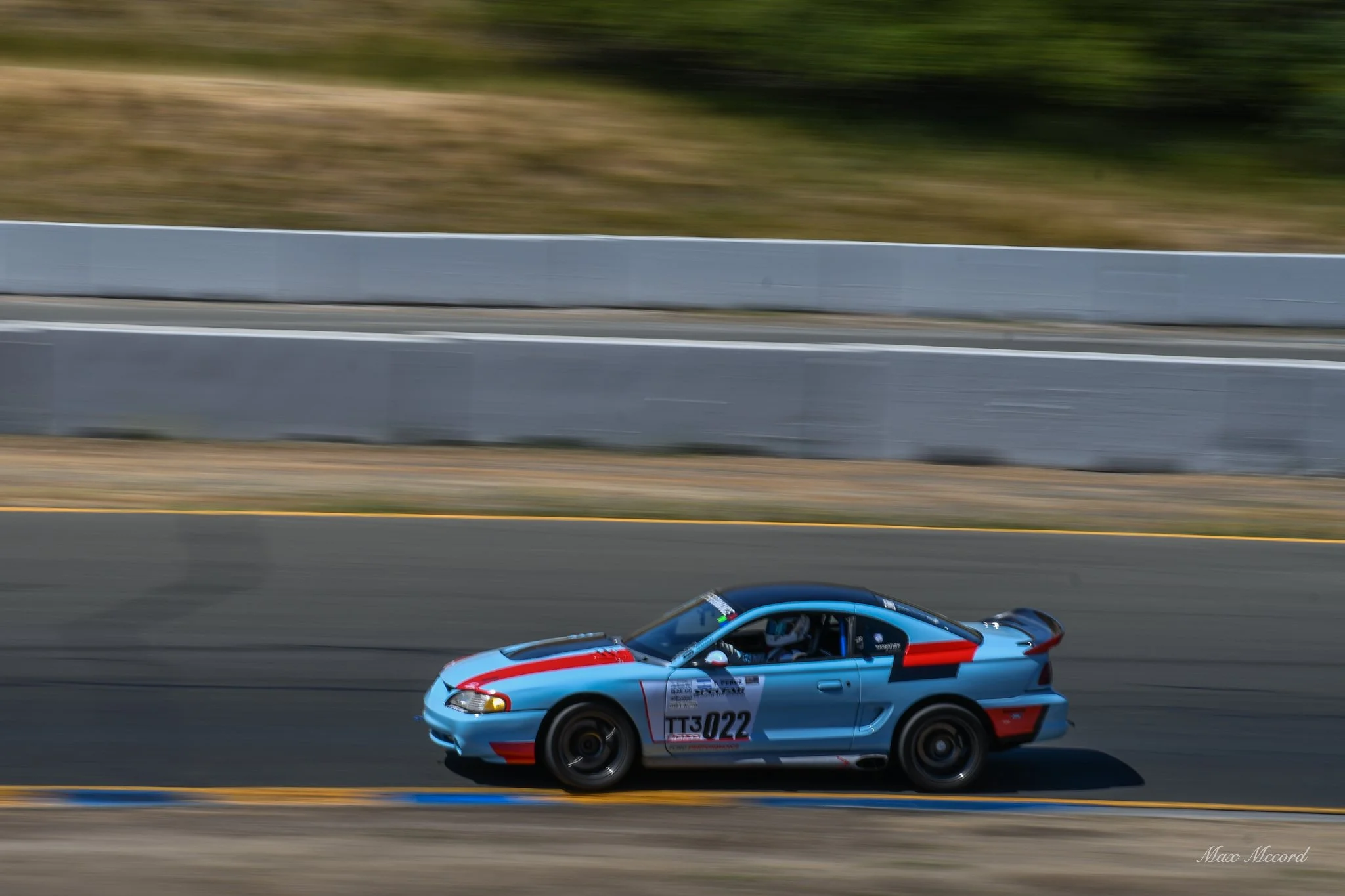
With all the right handling modifications in place, Frank dedicated himself to learning his craft. The modest power output of the first two-valve motor made that process a bit easier, but eventually began feeling a bit underwhelming. William Luketich built the next engine: a combination of 2V, 3V and 4V parts for a healthy 350 horsepower at the tires and a 7,100 rpm redline. That power was sent back to the Bullitt rear end with its Boss 302R T2R differential with a Ford Racing cooler and finned cover. The package was punchy, reliable, and was powerful enough for his next leap: time trials.
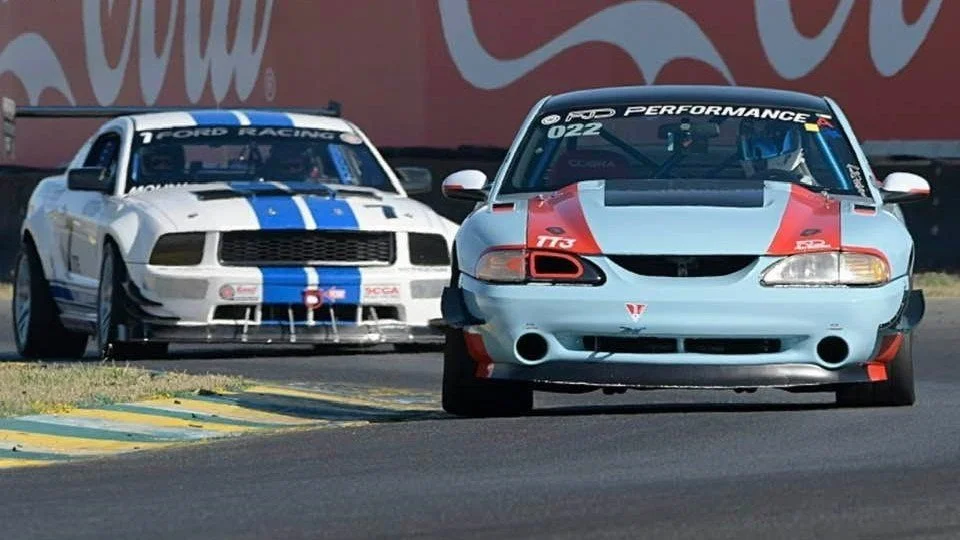
As he’d gotten accustomed to running on the road course, he had been crewing for Sal Molinare’s American Iron campaign in 2022. Being so close to sanctioned competition made him want to try it, but a limited budget and a dwindling class size in AIX had him rethink his next move.
He settled on a more cost-effective alternative: time trials. To be competitive, the Mustang would require another round of updates to lower weight and increase downforce. With Griggs carbon front fenders, a Griggs GR40 carbon hood, he helped improve front end bite and heat extraction from the engine bay.
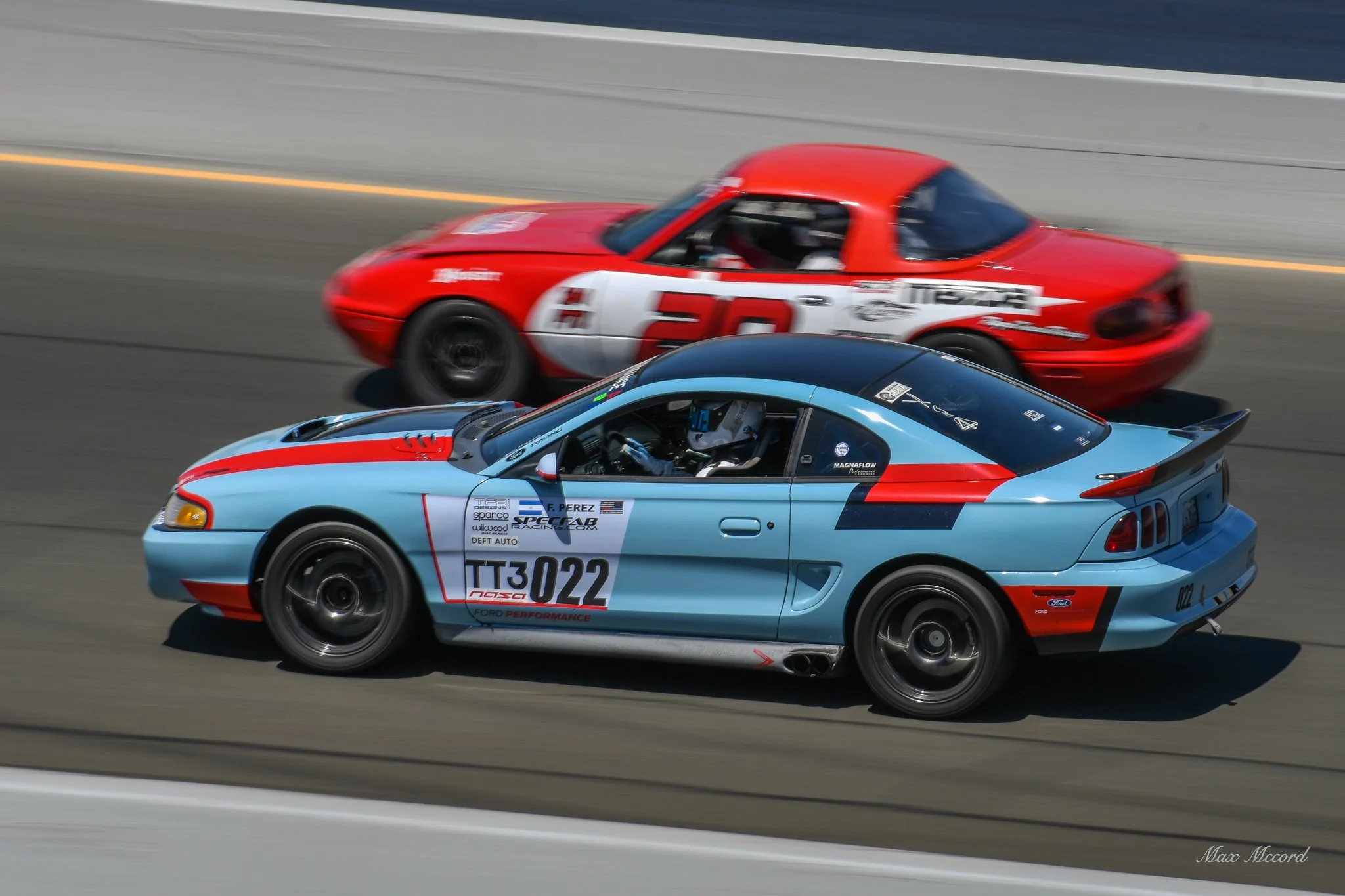
Frank’s designed a few different liveries for the car – the latest iteration an homage to Ken Miles’ Ford GT40 MK II and the Mustang GT4/FP350.
Then the 72” 9Lives Racing wing needed a bit of improvement, so he designed custom pylons which positioned the wing about an inch higher and six inches further back to bump downforce slightly. To complement all the rear grip he’d just added, he put together a front aero package comprised of a custom frame and splitter extending to the oil pan; AJ Hartman’s ducts, tunnels, sideplates, and canards; Professional Awesome quick releases; and Speed Italia titanium skidplates.
Sadly, that was the car’s high-point for the next year. Eventually the motor blew, and the Mustang was set on the back burner.
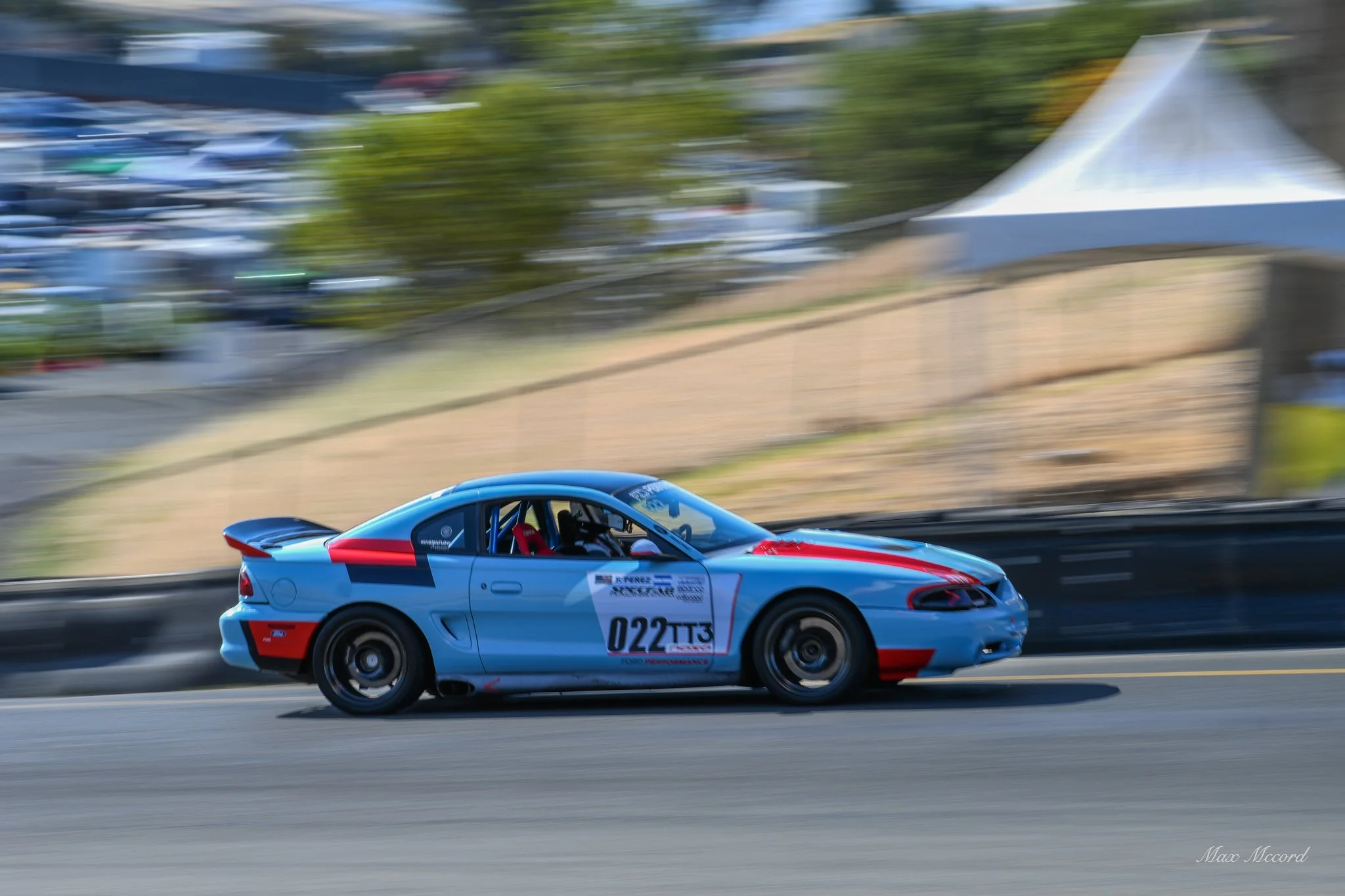
His next iteration will include a Tremec TKX close-ratio gearbox, a flat floor, an AJ Hartman diffuser, and a sub-3000-lb competition weight. “Besides all the interior I still need to cut out, there’s a carbon roof in my garage. Getting down to that race weight shouldn’t be too hard."
“The new setup is still being tweaked, but I’m aiming for sub 1:50s at Sonoma. That should be possible since, with the old motor and virtually no downforce, I put down a 1:54 on the same tires.
“I actively looked for influence and guidance from the likes of Mike Maier, Bruce Griggs, Sal Molinare, and Steve Libby. They’ve all taught me about chassis setup and emphasized the importance of driver mod,” he said.
The cherry on the sundae will be a new Coyote motor using a Gen 2 bottom end, a Gen 3 intake, an L&M cam, ARH longtube headers and 3” oval system; and a built head using Boss 302R springs, a Holley Terminator X ECU, and a Ford Racing baffled oil pan. This engine package should rev to 8,200 and produce somewhere around 500 horsepower – a power level that now, after so many years developing the chassis, should complement everything nicely. This car has spent its formative years without much in the way of power, and it’s helped Frank soften his inputs and conserve his momentum, what without much of a power advantage to fall back on. No doubt, he’ll be able to make good use of this power bump.